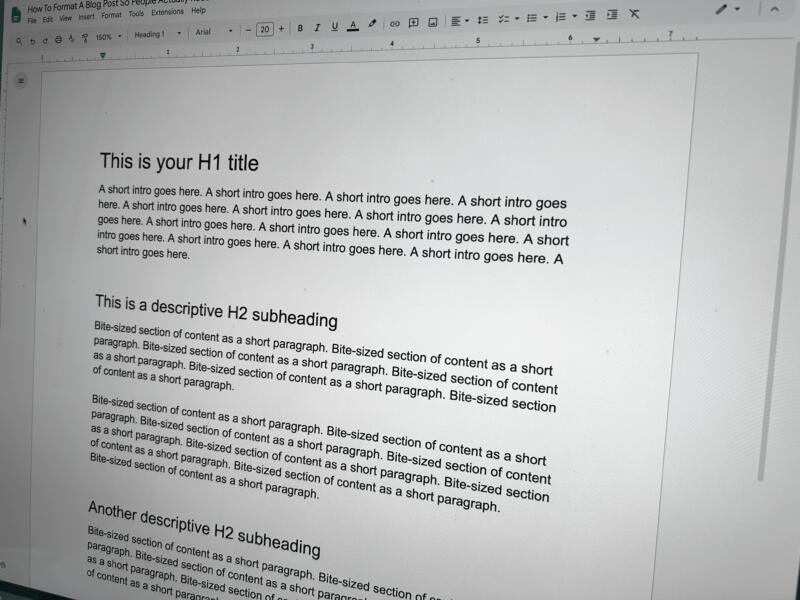
Blogging can be hard to get into. You come up with a topic, then spend hours researching and writing a genuinely useful article. But without knowing how to format a blog post, your efforts will be difficult to read. And if that happens, people probably won’t stick around long enough to read or appreciate it.
The format (or structure) of any blog post has always been important. It’s not just about making your content easier on the eye. A well-formatted post helps readers find what they want, understand what you’re saying, and decide whether it’s worth reading to the end.
And, alongside a normal Google search, people are using AI search (ChatGPT, Claude, etc.) to get answers quickly, so good content structure matters more than ever. So, how should you format a blog post to make it easier for people (and AI) to read?
Start with the answer, not a lengthy intro
Think about how you read blogs yourself. If you’re looking for an answer to a particular question, most of the time, you probably don’t want to wade through several paragraphs of background information before getting to it. Anyone reading your blog will feel the same.
Give each section a clear heading that reflects the question or topic. Then answer it directly in the opening paragraph before adding any supporting detail, examples, or explanations. So rather than using a vague heading like ‘Content Length Considerations’, try ‘How long should a blog post be?’. Simple – and effective.
This kind of blog post formatting is clearer, more specific, and tells readers exactly what to expect in that section. It also makes each section easier for search engines and AI tools to understand and reference your post.
Break up your content into bite-sized sections
Seeing large blocks of endless text can be off-putting, especially on mobile devices. Let’s face it, even if your post is engaging and exactly what people are searching for, being faced with a solid wall of words will have readers hitting the ‘back’ button at record speed.
To avoid that, just break up your content. Keep your paragraphs short and have each one focused on one point. You should also use descriptive H2 subheadings to make it easier for readers to skim and find what they need.
There’s no need to make every paragraph super short, though. The aim is to create a natural reading flow, not turn your blog into a gaggle of disconnected snippets.
Use lists and tables where they make sense
Bullet point lists and tables can be a handy addition to your post. They can help when you’re trying to compare options or outline a process. If you want to highlight the benefits of a particular product or service, then a short bullet point list will be easier to digest than an overly long paragraph.
Just don’t overdo it. Lists should support your writing, not replace it. Your blog still needs context, explanation, and a bit of your personality.
Add something original to your content
Good formatting makes information easier to access, but that doesn’t mean your content will stand out in a sea of sameness and AI-generated slop. To do that, you need to give readers something they won’t find in every other article on the same subject.
That could be anything, so bring some of your own knowledge and perspective to the table. Dig out some original research, add in some customer feedback, or give a useful stat or insight from your industry or sector. Don’t just repeat something that’s already ranking well.
Include naturally placed internal links
If you’re talking about a topic that’s covered in more detail somewhere on your website, use relevant anchor text to link to it within the sentence (see what I did there?!). So, this blog is about how to format a blog post, so it’s natural for me to add a link to my blog copywriting service page.
This helps readers discover related information, explore other pages on your site, and gives all the search engines useful context about how your content connects. Apart from anything else, it’s probably more useful than just dumping a load of unrelated links at the bottom of your article.
Good formatting starts with good writing
At the end of the day, an SEO-friendly blog structure still isn’t a substitute for useful, well-written content that gives genuine value. It’s only there to make that content easier to read, understand, and navigate.
The main thing is that most of the points included here – the things that make a blog post more accessible to a human reader – help search engines understand your content and AI tools interpret and reference it. This is a bonus as more people use AI-powered search for quick answers, including those ‘AI overview’ snippets at the top of a search page.
So clear headings, plain answers, and a decent structure all make a difference. Before hitting ‘publish’ on your next blog, take a look at it from your reader’s POV. Will it give them what they’re looking for? Is the information easy to follow? Does it give them some genuinely helpful information?
Get those things nailed, and your blog content has a much better chance of doing its job.
Need a hand with your blog posts?
Hopefully, this little lot has given you a few pointers on how to get the most out of your post. But it still takes time to do. So if you’d rather spend your time running your business and doing what you’re good at than tackling a blank page and a blinking cursor, I can help.
I work alongside SMEs, marketing teams, and creative agencies to write engaging, well-researched blog content that gives your audience something worth knowing. It also supports your wider marketing and SEO goals, so outsourcing your blog writing is a smart, strategic move.
Get in touch today to find out how I can help you create helpful content that gets found in search, answers customer questions, shows your expertise, and supports your long-term business growth.